
'Sup, Bro
Movies About Brothers Get Me Every Time

If you look at the long list of my all-time favorite movies, you'll notice a recurring theme: the complex, emotionally heavy burden and beauty of brotherhood. I’ve always been drawn to films that map this unique territory between brothers, from the fierce loyalty depicted in Steven Soderbergh’s King of the Hill and John Carney’s Sing Street, to the challenges of familial responsibility in Barry Levinson’s Rain Man, Sam Raimi’s A Simple Plan, and Lasse Hallström’s What’s Eating Gilbert Grape. Sibling bonds can be beautifully unconditional yet combative, like the twins in Spike Jonze’s Adaptation and the boxers in David O. Russell’s The Fighter, or they can be oppressively interdependent as the siblings in Woody Allen’s Crimes and Misdemeanors and Steve Kloves’ The Fabulous Baker Boys (starring real-life brother, Jeff and Beau Bridges).
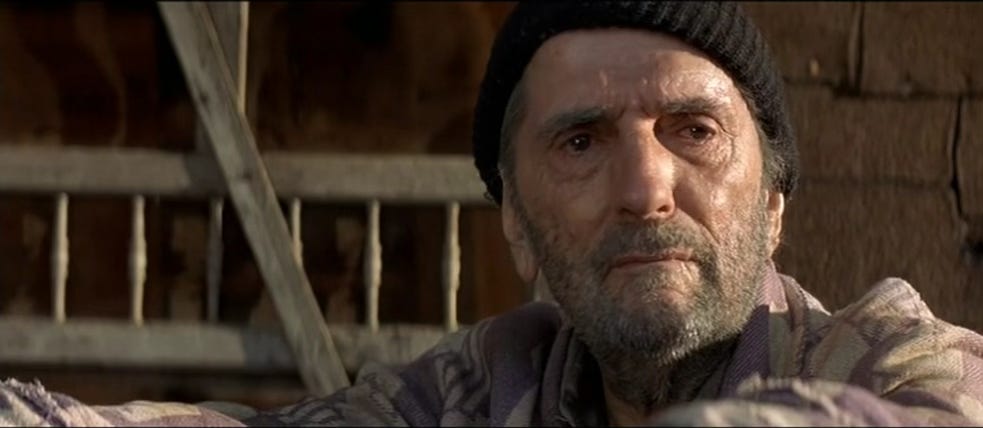
Add to this list a quiet masterpiece by David Lynch, The Straight Story. Released in 1999, the film stars Richard Farnsworth and Sissy Spacek, alongside the legendary Harry Dean Stanton—who happens to be the focus of an annual film festival in Kentucky in July. A celebration of the late character actor, the Harry Dean Stanton Film Festival runs the weekend of July 10–12 in Lexington.
The Straight Story centers on Alvin Straight (Farnsworth), an elderly WW2 veteran living with his daughter, Rose (Spacek), on an Iowa farm. When Alvin learns his estranged brother, Lyle (Stanton), has suffered a stroke, he is determined to mend their ten-year estrangement. Plagued by failing eyesight and a lack of a driver's license, Alvin builds a makeshift trailer, hitches it to a 1966 John Deere lawnmower, and sets out on a grueling, 240-mile journey to Wisconsin.
Farnsworth earned a well-deserved Oscar nomination for his fiercely dignified performance, and Spacek is brilliant as always. But the real shock of the film is Lynch himself. This is the director stripped of his usual signature darkness. There is nothing sinister, macabre, or grotesque here—no hidden rot beneath a small-town lawn like Blue Velvet, no nightmarish underworld like Twin Peaks, and no fever dreams like Lost Highwayor Mulholland Drive. Instead, Lynch gives us a purely humanist epic: a man on a tractor, crawling across the Midwest at five miles per hour. Alvin endures bad weather, mechanical breakdowns, and sheer physical exhaustion just to show up on a porch and look his brother in the eye. And Stanton’s famously “do nothing” performance is heartbreaking and beautiful.
Marking its 15th year (including a couple of dark and online years during the pandemic), the festival will feature screenings of his iconic work alongside special guests, including actors Josh Hopkins and Sean Young, and director Alison Anders. If you are anywhere near Lexington, I strongly recommend attending the festival to witness Stanton’s towering, quiet legacy on the big screen.