
Sit Next to Me
Grief, Grit(s), and Steel Magnolias

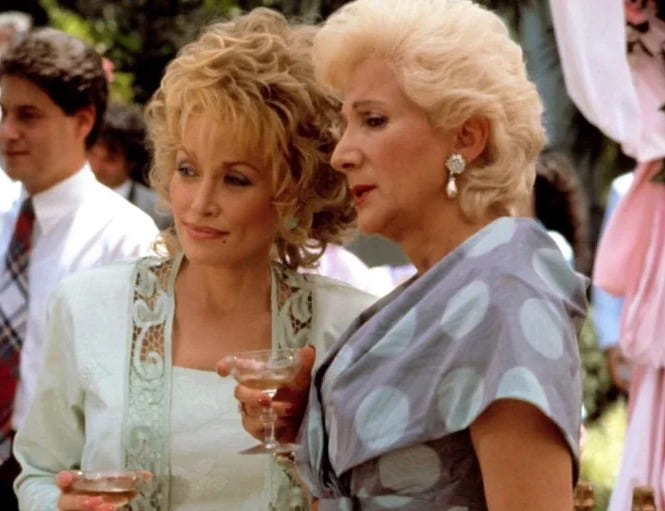
I’ve been thinking a lot about mothers lately. As my own elderly mother deals with recent, serious health issues, every film or series I watch that centers on a mother character feels heightened. A recent screening of Steel Magnolias, directed by Herbert Ross and written by Robert Harling (adapted from his stage play), did not help matters, but it did give me a chance to revisit this beloved classic.
If you’ve never seen the film, it is the story of Annelle (Daryl Hannah), a recent graduate of a beautician’s school who arrives in a small Louisiana town in search of a job. She is immediately hired by Truvy (Dolly Parton), the cheerful, kind-hearted owner of a salon that becomes the central hub and main gathering place for the other characters: Clairee (Olympia Dukakis), the wealthy, grieving widow of the town’s former mayor; Ouiser (Shirley MacLaine), a cantankerous grouch; and M’Lynn (Sally Field), a social worker, devoted wife, and mother to three sons and a daughter, Shelby (Julia Roberts), a nurse who’s about to get married to a handsome lawyer named Jackson (Dylan McDermott).
Over the span of a few years in the lives of these women, a lot happens. Without spoiling anything, the core focus remains on the relationship between M’Lynn and Shelby, a diabetic who, despite her doctors’ strong recommendations, decides to have a child. Spoiler alert: Bring tissues.
As M’Lynn and Shelby clash and collaborate, the other characters face their own obstacles. Annelle gets divorced, finds Jesus, and gets a boyfriend. Truvy and her despondent, underemployed husband, Spud (Sam Shepard), become more connected. Ouiser’s hard shell reveals a softer center. Clairee…? Well, she is grieving a little less for her husband by the end and buys a radio station.
I first saw the film when it was released in 1989, and I had not seen it again until last week. It is almost impossible not to like Steel Magnolias, especially if you are from the South. Almost. These are instantly recognizable characters and familiar settings. The performances are solid, especially from Sally Field as M’Lynn, who delivers one of the all-time great onscreen monologues toward the film’s end. But everyone is good.
I had forgotten how great Dolly Parton can be when given the right role. Forget her thin, clichéd quips in the salon; instead, watch her scene with the brilliant Shepard in the clip below. She is truly listening. Beware: spoilers ahead.
Even that simple line—“It makes you pretty”—is soaked in grief. It made me wish she had chosen to do more dramatic work over the years.
MacLaine, always good, spars winningly with everyone, especially Clairee and M’Lynn’s husband, Drum (Tom Skerritt). Every moment she is onscreen is rooted in authenticity. We believe it because MacLaine believes it. She is fully invested in this wacky character but never seems to be “acting.” The same goes for Dukakis, who isn’t a Southerner but pulls it off better than I thought the first time I saw it.
Now, to quote Clairee: “If you can’t say something nice… sit next to me.”
Despite moments of real depth and beauty in Julia Roberts’ Oscar-nominated performance, her Southern accent was cartoonish and incongruent with her own onscreen family’s. It is probably a non-issue for most people, but as someone from the South, it was significant enough to take me out of the story many times.
Most egregious was the decision to make Hannah’s Annelle so clumsy, obvious, and over-the-top, detracting from her fewer, more subtle moments. Annelle is the character who changes the most over the course of the story, but she often comes across like someone in an SNL sketch. A director’s main job is to monitor performances, and from what I can see, Ross was looking elsewhere when it came to Annelle. To be fair, it would be hard for anyone to impose restraint or find cohesion while directing a powerhouse cast like this.
Don’t get me wrong, I still love the film. In addition to the scenes with Sally and Dolly, other moments that deliver a massive emotional impact are worth celebrating: the way the ongoing quarrel between Ouiser and Drum resolves; the raucous wedding reception that’s so authentic it feels like documentary footage; Drum’s gentle embrace of his despondent son. There’s also the scene where we learn Shelby has diabetes which contains a line of dialogue I’ve heard people (mostly gay men) quote since the movie premiered (“Drink your juice, Shelby!”). Upon re-watch, it played differently. What I had remembered as overly melodramatic turned out to be extraordinarily affecting—largely thanks to Roberts and Field.
My favorite moment in the film, both as a director and a Southerner, is what’s known as a transition scene, taking us from one scene to the next. With no dialogue, it reveals so much. I love it for its simplicity and its realness. Watch the clip below and tell me Sally Field’s M’Lynn isn’t the embodiment of every strong Southern woman you’ve ever known.
Or maybe she just reminded me of my own Mom.
I love this!